
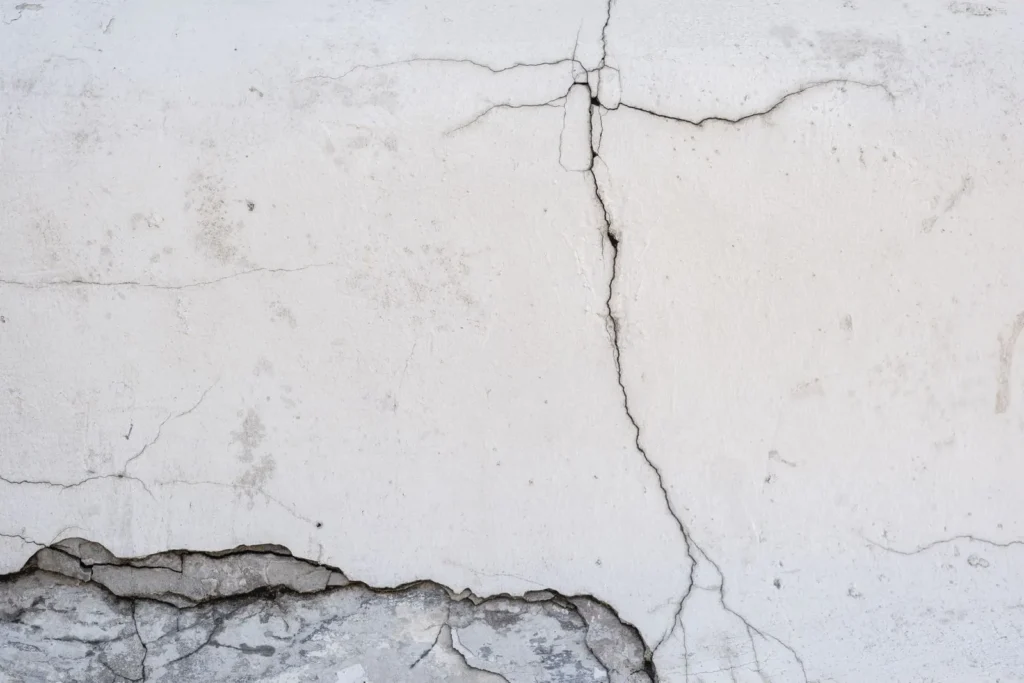
Almost every house has cracks. Most are harmless and can be fixed with a good render repair; a few are the first sign of a structural problem. Knowing how to read a crack — its shape, direction, width and whether it is growing — is what separates a cosmetic repair from work that really has to be done.
In short
- Fine, map-like cracks in render are usually mortar shrinkage: cosmetic.
- Straight cracks where concrete meets brick come from materials moving differently: treat them with mesh and movement joints.
- Diagonal or stepped cracks that are wider at one end, or doors starting to stick, may point to movement of the structure or foundations: call a structural engineer.
- Monitor before repairing: an active crack will always reopen.
Why walls crack
A crack appears when a material is forced to deform more than it can. Mortars and masonry are strong in compression but very weak in tension: small strains are enough to crack them. The most common causes are:
- Shrinkage of mortar and concrete as they dry.
- Temperature and moisture changes, which make materials expand and contract.
- Different behaviour of materials in contact (concrete, brick, plaster, timber).
- Deflection of slabs and beams over time (creep), which either load the walls below or stop supporting them from above.
- Differential settlement of foundations, when one part of the building sinks more than another.
- Rebar corrosion, which makes concrete burst from the inside.
Reading the crack: the most common patterns
Fine, shallow, map-like cracks
They look like “crocodile skin” or a map. They stay in the render or paint and result from mortar shrinkage (too much water or cement, fast drying, layers that are too thick). They have no structural significance.
Straight cracks where structure meets masonry
Horizontal under beams and slabs, or vertical along columns. Concrete and brick expand, contract and deform differently, and the joint between them opens. Very common in reinforced-concrete buildings with masonry infill walls.
Cracks on the top floor
The roof slab heats up and cools down much more than the rest of the building. As it expands it drags the top of the walls, creating horizontal cracks near the ceiling or diagonal cracks at the corners of the top floor. Improving roof insulation reduces the cause.
Diagonal cracks from the corners of doors and windows
The corners of openings concentrate stress. Fine, stable cracks may just be shrinkage; cracks that grow, especially when doors or windows no longer close properly, may indicate structural deformation or settlement.
Stepped cracks that are wider at one end
They follow the masonry joints in steps and open more on one side. This is the typical pattern of differential foundation settlement. They should always be assessed by an engineer.
Cracks along reinforcement, with rust stains
In beams, columns, balcony slabs or ceilings, cracks running parallel to the bars, sometimes with concrete “popping” and brown stains, indicate rebar corrosion. It is a durability problem — and, if advanced, a safety one.
How wide is the crack?
Width doesn’t tell the whole story, but it is a good starting point. A classification widely used internationally for damage to low-rise buildings (BRE Digest 251) relates crack width to damage severity:
| Approximate width | Damage | What it usually means |
|---|---|---|
| Up to 0.1 mm | Negligible | Hairline cracks; dealt with when repainting |
| Up to 1 mm | Very slight | Fixed during normal redecoration |
| Up to 5 mm | Slight | Open up and fill; doors and windows may stick |
| 5 to 15 mm | Moderate | Masonry repair, possibly work on window frames and services |
| 15 to 25 mm | Severe | Rebuilding sections of wall; structural investigation |
| Over 25 mm | Very severe | Major structural repair; possible propping |
More important than today’s width is knowing whether the crack is growing.
Monitor before you repair
- Mark and date the ends of the crack in pencil and photograph it with a ruler alongside.
- Use a crack-width gauge to measure the width, always at the same point.
- Fit tell-tales — small plaster seals or plastic crack monitors fixed across the crack. If they break or shift, the crack is active.
- Keep records for several weeks or months, ideally across different seasons: some cracks open and close with temperature without actually growing.
How they are repaired
Stable cracks in render
- Rake the crack out into a “V” and remove loose material.
- Clean and dampen (or prime, depending on the product).
- Fill with a mortar compatible with the substrate, or a repair filler.
- Where different materials meet, embed a fibreglass mesh in a new coat of render or filler, extending well beyond the crack on each side, to spread the movement.
- Once dry, paint with a good-quality or elastomeric paint.
Cracks that open and close
When movement is unavoidable (for example due to temperature changes), filling with a rigid material is pointless: the crack reopens. The solution is to create a movement joint, sealed with a flexible sealant, in a controlled and visually acceptable position.
Structural cracks
First the cause is dealt with — underpinning foundations, strengthening beams or slabs, correcting loads — following a design by a structural engineer. Only then are the cracks repaired, for example by resin injection in concrete elements or stitching masonry.
Warning signs: call an engineer if…
- the crack grows over time or is several millimetres wide;
- it is diagonal or stepped and wider at one end;
- doors and windows have started to stick or floors have become uneven;
- it appears in beams, columns or slabs, or has rust stains;
- it appeared after neighbouring building work, excavation, water leaks or changes to the building (for example, removing walls).
References
- Building Research Establishment — BRE Digest 251: Assessment of damage in low-rise buildings.
- EN 1992-1-1 — Eurocode 2: Design of concrete structures (crack control).
- EN 1996-1-1 — Eurocode 6: Design of masonry structures.
Got this problem at home?
Socripe carries out an on-site diagnosis and proposes the right repair, with an itemised quote — in English. We work in Sesimbra, Seixal, Setúbal, Almada, Barreiro and Palmela.