
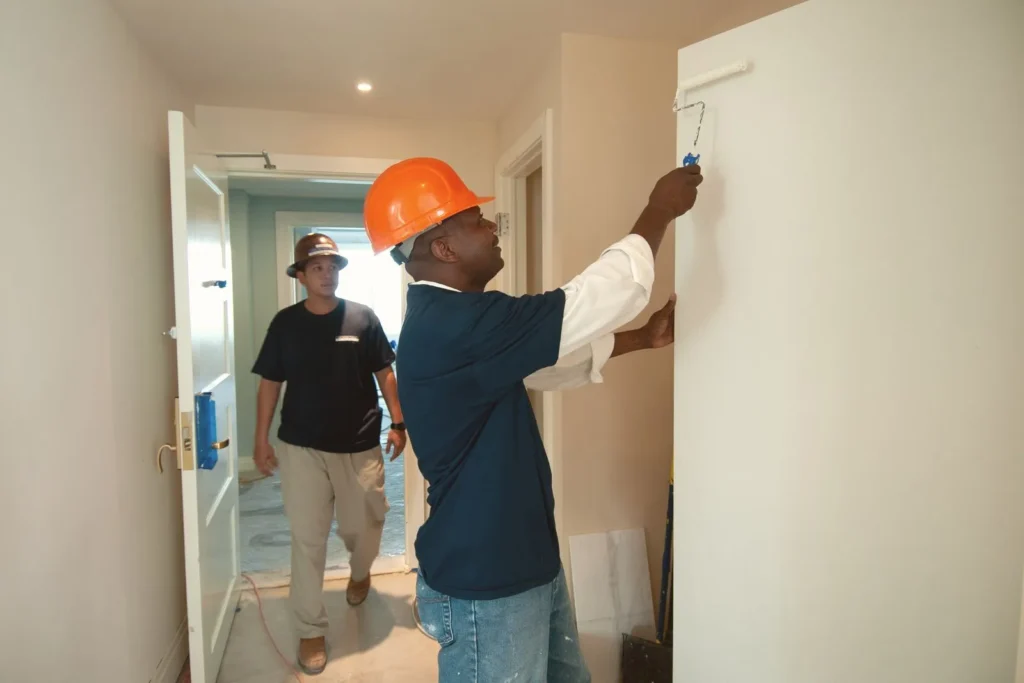
“Do I need a permit from the Câmara to renovate?” If you have bought a flat or house in Portugal, it is probably one of your first questions. For most interior renovations the answer is no — but “no permit needed” does not mean “anything goes”. This guide explains what is usually exempt, what isn’t, and the rules that always apply, even without paperwork at the town hall.
In short
- Interior works that do not affect the structure, façades, roof or building height are, as a rule, exempt from a licence and from prior notification.
- Touching the structure (load-bearing walls, columns, beams, slabs) always requires a qualified engineer and, depending on the case, a procedure with the Câmara.
- Façades, balconies, windows with a different design, roofs and extensions are generally subject to municipal control and, in an apartment building, to condominium approval.
- Exempt doesn’t mean rule-free: noise rules, the condominium, safety, technical standards and a licensed contractor always apply.
The law is changing
Portugal’s planning and building code (RJUE — Regime Jurídico da Urbanização e Edificação) was substantially amended by the “Simplex Urbanístico” (Decree-Law 10/2024) and again in 2026 (Decree-Law 108/2026). This article is for information only and does not replace confirmation with the Câmara Municipal (the local municipality) or a qualified professional — especially for listed buildings, historic centres or any case of doubt.
A few Portuguese terms you will hear
- Câmara Municipal — the local municipality / town hall, which handles planning.
- Licença — building licence (full permit).
- Comunicação prévia — prior notification: you file the project and can start, with checks afterwards.
- Isento de controlo prévio — exempt from both.
- Condomínio — the owners’ association of an apartment building.
- IMPIC — the public body that licenses construction contractors.
What is usually exempt
The RJUE (Article 6) exempts from prior control alteration works inside buildings or units that improve, do not harm or do not affect the structural stability and do not change the building height, the shape of the façades or roofs, nor remove façade tiles (azulejos). In an apartment renovation this usually covers:
- Replacing floors and wall finishes, painting, new suspended ceilings.
- Renovating the kitchen and bathroom, including indoor plumbing and drainage.
- Rewiring the interior electrical installation (with certification where applicable).
- Removing or building non-structural partition walls (light brick, plasterboard).
- Replacing interior doors and joinery.
There is also a list of works of minor planning relevance (Article 6-A), which includes, for example, replacing window materials with others that have an identical external finish and improve energy efficiency. Small outdoor structures (sheds, boundary walls, greenhouses, solar panels) have their own limits and may be restricted by local regulations.
What is usually not exempt
- Structural alterations: openings in load-bearing walls, removing columns, cutting slabs, adding significant loads. Even where the law allows them without a licence, a qualified engineer must assess the solution and take responsibility for it.
- Façades: changing the design or colour of openings, enclosing balconies, different cladding, removing façade tiles.
- Roofs and extensions: adding floors or area, changing the roof shape, building attic rooms.
- Changes of use (e.g. from shop to dwelling) and works on listed buildings or within their protection zones.
These cases may require a licence or prior notification, with designs and responsible professionals. The right route depends on the works and the location — which is why a technical visit before you start saves time and money.
Rules that always apply
The condominium
In an apartment building, works that change the architectural line or aesthetic appearance of the building need approval from the owners’ meeting by a two-thirds majority of the building’s total value (Civil Code, Article 1422). Even for interior works, tell the building administration, protect the common areas and check the condominium rules (hours, lift use, rubble removal).
Noise
Portugal’s General Noise Regulation only allows renovation, refurbishment or maintenance works inside residential buildings on working days, between 8 am and 8 pm, and requires a notice in a place visible to neighbours stating the expected duration of the works and, where possible, the noisiest period.
Safety and technical standards
Being exempt from a licence does not exempt you from technical rules: structural safety, electrical and gas installations, ventilation, fire safety, energy performance. Gas and electrical work still require the mandatory certification and inspections.
A licensed contractor
In Portugal, anyone carrying out building work must be licensed by IMPIC (an “alvará” or contractor certificate, depending on the type and value of the work). You can check this on IMPIC’s website. Since the 2026 changes, the liability of owners, contractors and site managers has been reinforced — one more reason to work with people who know the rules.
Checklist before you start
- Check whether the works touch the structure, façades or roof.
- Check whether the property is in a protected area or historic centre (municipal master plan, Câmara services).
- Get the property’s drawings from the municipal archive to know which walls are load-bearing.
- Talk to the condominium and put up the works notice.
- Ask for an itemised quote and confirm the contractor’s licence.
- Keep invoices, certificates and photos of the works — you will need them if you sell.
References
- Decree-Law 555/99 — Regime Jurídico da Urbanização e Edificação (RJUE), Articles 6 and 6-A, current wording. pgdlisboa.pt
- Decree-Law 10/2024 (Simplex Urbanístico) and Decree-Law 108/2026 — amendments to the RJUE. diariodarepublica.pt
- Portuguese Civil Code, Article 1422 — Limits on condominium owners’ rights.
- Decree-Law 9/2007 — General Noise Regulation (Regulamento Geral do Ruído), Article 16. diariodarepublica.pt
Renovating a property in Portugal?
Socripe visits the property, checks what your project requires and gives you an itemised quote in English, with a 3D preview. We work in Sesimbra, Seixal, Setúbal, Almada, Barreiro and Palmela.