
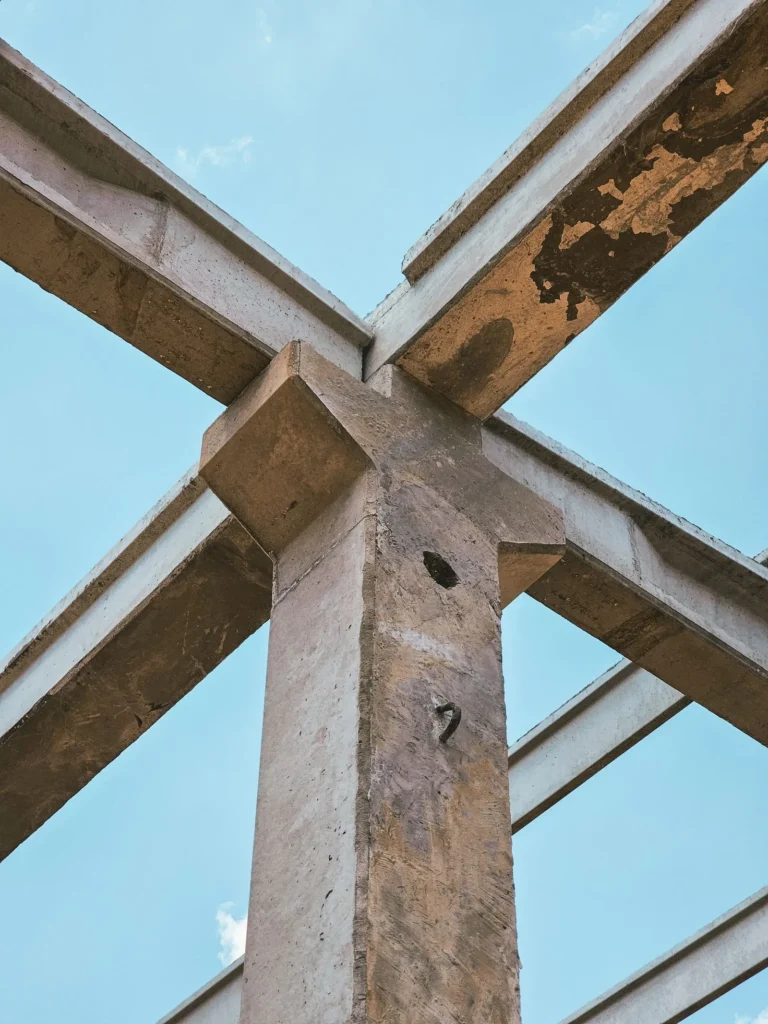
Balconies with concrete falling off, garage columns with steel bars showing, bathroom ceilings with flakes and rust stains. People often call it “rotten concrete”, but the problem is rarely the concrete itself: it is the steel inside, which rusts, swells and bursts the concrete. South of Lisbon, close to the sea and the estuaries, it is a very common defect.
In short
- Cause: the reinforcement loses its natural protection through carbonation of the concrete or through chlorides (marine environment).
- Signs: cracks along the bars, rust stains, concrete that sounds hollow and comes away.
- Proper repair: remove all contaminated concrete, clean and protect the steel, rebuild with structural repair mortar and protect the surface — following the EN 1504 standard.
- Patching with ordinary mortar hides the problem for a short while and can speed up corrosion around it.
Why steel (normally) doesn’t rust
Concrete is highly alkaline (pH around 12.5 to 13.5). In that environment a microscopic film forms on the steel and protects it — the steel is said to be passivated. As long as that protection lasts, the steel does not corrode, even when damp. Two mechanisms destroy it:
Carbonation
Carbon dioxide from the air slowly penetrates the pores of the concrete and reacts with the alkaline compounds, lowering the pH. When the carbonation front reaches the reinforcement, the steel loses its protection and, with moisture and oxygen present, starts to corrode. It advances faster in porous concrete, low in cement or poorly compacted, and when the cover (the thickness of concrete over the steel) is small — a very common defect in buildings from the 1960s to the 1990s.
Chlorides
Chlorides — from sea air, seawater, poorly washed sand or old admixtures — destroy the protective film locally even at high pH, causing pitting corrosion that can greatly reduce the bar’s cross-section without much visible expansion. Buildings near the coast (Sesimbra, Costa da Caparica, Setúbal, the banks of the Tagus and Sado) are particularly exposed.
Why the concrete bursts
Rust takes up several times the volume of the steel it came from. That expansion creates internal pressure that cracks the concrete along the bars, then splits it into layers (delamination) and finally makes it spall off, exposing the steel — which, unprotected, corrodes even faster.
Where it appears most
- Balcony slabs and canopies, especially at the edges and underneath.
- Parapets, cornices and projecting elements on the façade.
- Columns and beams in garages and basements (damp, poor ventilation).
- Bathroom and kitchen ceilings (constant humidity, sometimes leaks).
- Areas where water collects: no drip edges, wrong falls or deteriorated waterproofing.
Diagnosis
- Visual inspection and recording of cracks, stains and spalling.
- Hammer tapping: delaminated concrete sounds hollow — this marks out the area to repair, which is almost always larger than the visible one.
- Phenolphthalein test: on a freshly broken concrete surface, the solution turns pink where the concrete is still alkaline and stays colourless where it is carbonated. It shows the carbonation depth in seconds.
- Cover measurement with a rebar locator (covermeter).
- Chloride content, from concrete dust samples analysed in a laboratory, when contamination is suspected.
- Assessment of section loss in the bars. If it is significant, or if the defect affects important elements (columns, beams, cantilevers), a structural engineer must assess safety and, if necessary, design strengthening.
How it is repaired properly
The European standard EN 1504 sets out the principles and products for the protection and repair of concrete structures. In a typical local repair, the steps are:
- Mark out and remove all cracked, delaminated and contaminated concrete (carbonated at the steel or containing chlorides), fully exposing the affected bars with space behind them for the mortar to surround the steel.
- Clean the reinforcement back to bright metal, removing all rust (mechanical wire brushing or abrasive blasting).
- Assess and, if necessary, replace or supplement bars with significant section loss, as specified by an engineer.
- Protect the reinforcement with a suitable passivating or anti-corrosion coating.
- Rebuild the concrete with structural-class repair mortar (classes R3 or R4 under EN 1504-3), applied to the prepared substrate and properly cured.
- Protect the surface with an anti-carbonation or water-repellent coating (EN 1504-2) and fix the sources of moisture: drip edges, falls, waterproofing, ventilation.
Where chlorides or widespread corrosion are present, techniques such as galvanic anodes embedded in the repair, corrosion inhibitors or cathodic protection may be justified.
The classic mistake: the patch
Chipping out only the part that fell, painting the bar and covering it with ordinary cement mortar seems to fix it, but it leaves contaminated concrete and corroding steel all around. Corrosion often speeds up precisely at the edge of the patch (the so-called “incipient anode” effect). Within a few years the problem reappears next to it — and bigger.
A safety issue
Pieces of concrete falling from balconies and façades can injure passers-by. In apartment buildings these repairs usually involve the condominium (the owners’ association). Regular inspections and timely repairs are much cheaper and safer than waiting for concrete to fall.
References
- EN 1504 (parts 1 to 10) — Products and systems for the protection and repair of concrete structures.
- EN 206 — Concrete: specification, performance, production and conformity (exposure classes XC and XS).
- LNEC — DURATI project: Reparação de estruturas de betão (Repair of concrete structures). durati.lnec.pt
- University of Porto — Inspeção e reabilitação de estruturas segundo a NP EN 1504 (Inspection and rehabilitation of structures under EN 1504). repositorio-aberto.up.pt
Got this problem at home?
Socripe carries out an on-site diagnosis and proposes the right repair, with an itemised quote — in English. We work in Sesimbra, Seixal, Setúbal, Almada, Barreiro and Palmela.